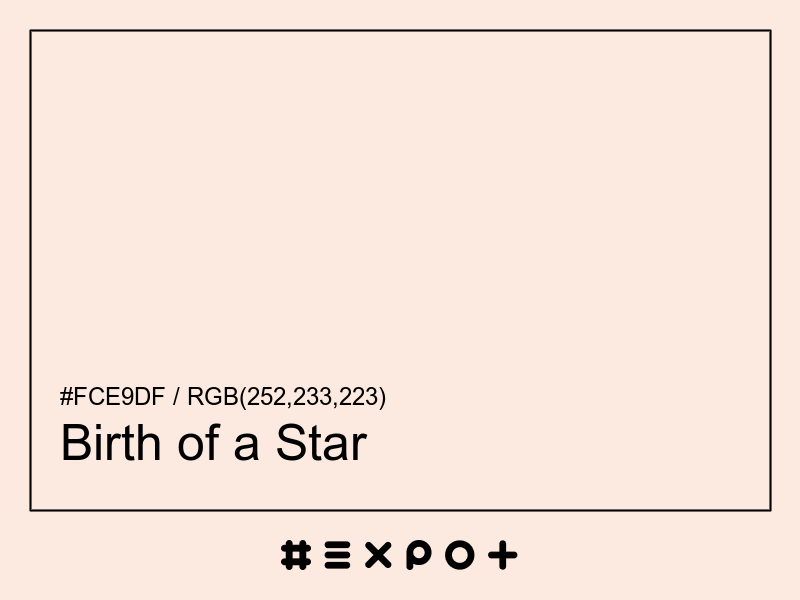
Birth of a Star is pale, warm-toned shade of warm red. It is better contrasting with black. This color combines beautifully with cool cyan, cool magenta or cool green
| Inverse Color | #031620 |
| Complementary Color | #dff2fc |
| Color Shade: | warm red (20.69° hue) |
| Color Temperature: | warm |
| Lightness: | 93.14% (better contrasting with black) |
If you're looking for a similar warm red shade, there are some better alternatives to Birth of a Star Color. The Autumn Wind color for instance is a darker and a bit more vibrant option, however this color has a mid red bias. Consider a darker and more soft alternative called Royal Milk Tea (#f7cfb4) for more calm effect. Try Butterfly Wing as it also a bit more vibrant and energetic.
#dff2fc is the best complementary color to Birth of a Star. Cool cyan shades generally complement the warm red hues best as they are found on the opposite end of the color wheel. The most popular #fce9df complementary color is Foam, as it offers maximum contrast and grab the viewer's attention.
The analogous palette of cool red, warm red, and warm yellow colors offers a soft combination of similar warm shades. The analogous colors of Old Lace are #fcdfe3 and #fcf7df. Thus found on the left and right of #fce9df on the color wheel with a 30° gap. Consider matching Cinderella and Pearl Lusta colors as they work well with Birth of a Star.
The split-complementary Birth of a Star palette consists of #dfe3fc and #dffcf7 colors. They can be found 30° apart on either side of the complementary color (#dff2fc). Try Hawkes Blue and Foam colors in combination with #fce9df, as they are not as contrasting as a complementary color, hence, giving more hue variety to make your design stand out.
The triadic palette of #fce9df offers a combination of warm blue and cool green shades and equally high contrast between the three of them. Find triadic colors at the 120° distance from the Birth of a Star. Thus Selago and Scandal giving maximum hue separation to use all three together.
The square color palette of Birth of a Star contains three additional colors. Thus, complementary Foam, Feta, and Selago split by 90° on the color wheel. #fce9df square combo is a palette of warm red, warm green, cool cyan and cool magenta shades that work together well.
The tetradic palette is a bit more complex than the square and has more of a rectangle shape. Birth of a Star tetradic combo consists of cool cyan complementary color (#dff2fc) and two others. The Scandal is positioned 120° clockwise from the primary color and Classic Rose – 120° from the complementary Foam. This palette is not recommended to use as-is. Try to tweak the saturation and brightness of #dffce9 and #fcdff2.
In a RGB color space, hex #fce9df is made of 36% red, 33% green and 31% blue. In a HSL mode Birth of a Star has a hue angle of 20.69°, a saturation of 82.86% and a lightness of 93.14%. In a CMYK space (used in printing only), hex #fce9df is made of 0% cyan, 7.45% magenta, 11.37% yellow and 1.18% black ink.
| HEX | #fce9df |
| RGB Decimal | rgb(252,233,223) |
| RGB Percentage | 36%, 33%, 31% |
| CMYK | 0, 7.45, 11.37, 1.18 |
| HSL | hsl(20.69,82.86%,93.14%) |
| HSV (or HSB) | hsv(20.69,11.51%,98.82%) |
| CIE-LAB | lab(93.5811,4.8189,7.1705) |
| XYZ | xyz(82.6031,84.301,81.7301) |