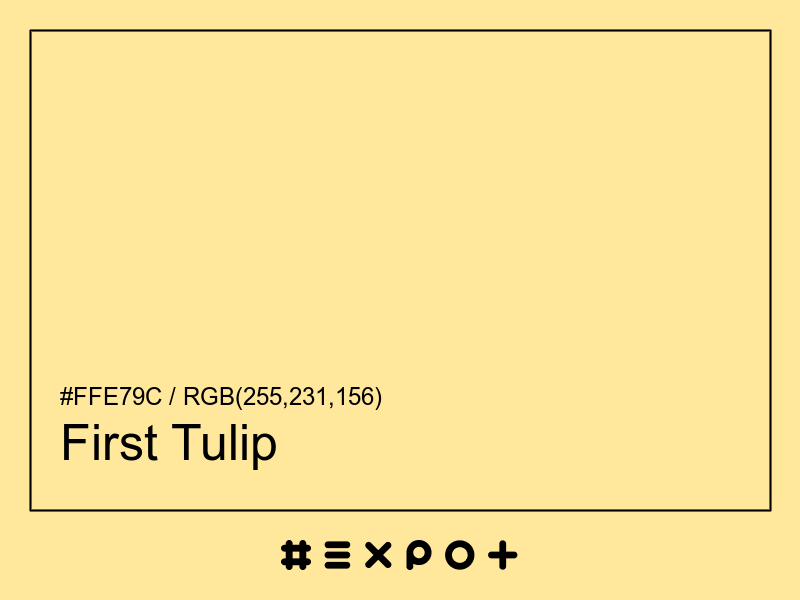
First Tulip Color

#ffe79c

First Tulip is calm, warm-toned shade of warm yellow. It is better contrasting with black. This color combines beautifully with cool blue, warm magenta or warm cyan

Inverse Color #001863
Complementary Color #9cb3ff
Color Shade: warm yellow (45.45° hue)
Color Temperature: warm
Lightness: 80.59% (better contrasting with black)
First Tulip Color Sample

Better Alternatives To #ffe79c

If you're looking for a similar warm yellow shade, there are some better alternatives to First Tulip Color. The Provence Creme color for instance is a lighter and a bit more faded option, however this color has a orange bias. Consider a lighter and more soft alternative called Milk Froth (#ffeecc) for more calm effect. Try Sandy Beach as it also a bit more faded and calm.

Complementary Palette

#9cb3ff is the best complementary color to First Tulip. Cool blue shades generally complement the warm yellow hues best as they are found on the opposite end of the color wheel. The most popular #ffe79c complementary color is Melrose, as it offers maximum contrast and grab the viewer's attention.

Analogous Palette

The analogous palette of warm red, warm yellow, and cool yellow colors offers a soft combination of similar warm shades. The analogous colors of Cream Brulee are #ffb59c and #e5ff9c. Thus found on the left and right of #ffe79c on the color wheel with a 30° gap. Consider matching Wax Flower and Jonquil colors as they work well with First Tulip.

Split-complementary Palette

The split-complementary First Tulip palette consists of #b59cff and #9ce5ff colors. They can be found 30° apart on either side of the complementary color (#9cb3ff). Try Melrose and Anakiwa colors in combination with #ffe79c, as they are not as contrasting as a complementary color, hence, giving more hue variety to make your design stand out.

Triadic Palette

The triadic palette of #ffe79c offers a combination of cool magenta and warm cyan shades and equally high contrast between the three of them. Find triadic colors at the 120° distance from the First Tulip. Thus Mauve and Aquamarine giving maximum hue separation to use all three together.

Square Palette

The square color palette of First Tulip contains three additional colors. Thus, complementary Melrose, Mint Green, and Lavender Rose split by 90° on the color wheel. #ffe79c square combo is a palette of warm yellow, cool green, cool blue and warm magenta shades that work together well.

Tetradic Palette

The tetradic palette is a bit more complex than the square and has more of a rectangle shape. First Tulip tetradic combo consists of cool blue complementary color (#9cb3ff) and two others. The Aquamarine is positioned 120° clockwise from the primary color and Pink Salmon – 120° from the complementary Melrose. This palette is not recommended to use as-is. Try to tweak the saturation and brightness of #9cffe7 and #ff9cb3.

Conversion Table

In a RGB color space, hex #ffe79c is made of 40% red, 36% green and 24% blue. In a HSL mode First Tulip has a hue angle of 45.45°, a saturation of 100% and a lightness of 80.59%. In a CMYK space (used in printing only), hex #ffe79c is made of 0% cyan, 9.41% magenta, 38.82% yellow and 0% black ink.

HEX #ffe79c
RGB Decimal rgb(255,231,156)
RGB Percentage 40%, 36%, 24%
CMYK 0, 9.41, 38.82, 0
HSL hsl(45.45,100%,80.59%)
HSV (or HSB) hsv(45.45,38.82%,100%)
CIE-LAB lab(92.048,-2.0154,39.4927)
XYZ xyz(75.8167,80.8121,43.0548)
;