Green Lizard is vibrant, warm-toned shade of cool yellow. It is better contrasting with black. This color combines beautifully with warm blue, cool red or cool cyan
| Inverse Color | #580bcd |
| Complementary Color | #7f31f4 |
| Color Shade: | cool yellow (83.81° hue) |
| Color Temperature: | warm |
| Lightness: | 57.65% (better contrasting with black) |
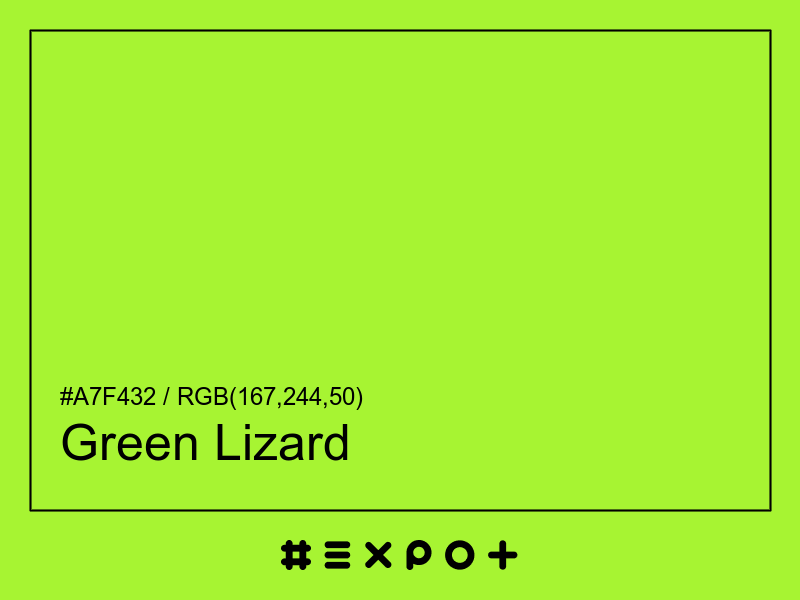
If you're looking for a similar cool yellow shade, there are some better alternatives to Green Lizard Color. The Chartreuse color for instance is a darker and a bit more vibrant option, however this color has a mid yellow bias. Consider a darker and more soft alternative called Akhdhar Green (#b0e313) for more calm effect. Try Pear Spritz as it also a bit more vibrant and energetic.
#7f31f4 is the best complementary color to Green Lizard. Warm blue shades generally complement the cool yellow hues best as they are found on the opposite end of the color wheel. The most popular #a7f432 complementary color is Electric Violet, as it offers maximum contrast and grab the viewer's attention.
The analogous palette of warm yellow, cool yellow, and warm green colors offers a soft combination of similar warm shades. The analogous colors of Green Yellow are #f4e031 and #46f431. Thus found on the left and right of #a7f432 on the color wheel with a 30° gap. Consider matching Golden Dream and Harlequin colors as they work well with Green Lizard.
The split-complementary Green Lizard palette consists of #df31f4 and #3145f4 colors. They can be found 30° apart on either side of the complementary color (#7f31f4). Try Heliotrope and Royal Blue colors in combination with #a7f432, as they are not as contrasting as a complementary color, hence, giving more hue variety to make your design stand out.
The triadic palette of #a7f432 offers a combination of warm magenta and cool cyan shades and equally high contrast between the three of them. Find triadic colors at the 120° distance from the Green Lizard. Thus Persian Rose and Dodger Blue giving maximum hue separation to use all three together.
The square color palette of Green Lizard contains three additional colors. Thus, complementary Electric Violet, Bright Turquoise, and Pomegranate split by 90° on the color wheel. #a7f432 square combo is a palette of cool yellow, warm cyan, warm blue and cool red shades that work together well.
The tetradic palette is a bit more complex than the square and has more of a rectangle shape. Green Lizard tetradic combo consists of warm blue complementary color (#7f31f4) and two others. The Dodger Blue is positioned 120° clockwise from the primary color and Jaffa – 120° from the complementary Electric Violet. This palette is not recommended to use as-is. Try to tweak the saturation and brightness of #31a7f4 and #f47f31.
In a RGB color space, hex #a7f432 is made of 36% red, 53% green and 11% blue. In a HSL mode Green Lizard has a hue angle of 83.81°, a saturation of 89.81% and a lightness of 57.65%. In a CMYK space (used in printing only), hex #a7f432 is made of 30.2% cyan, 0% magenta, 76.08% yellow and 4.31% black ink.
| HEX | #a7f432 |
| RGB Decimal | rgb(167,244,50) |
| RGB Percentage | 36%, 53%, 11% |
| CMYK | 30.2, 0, 76.08, 4.31 |
| HSL | hsl(83.81,89.81%,57.65%) |
| HSV (or HSB) | hsv(83.81,79.51%,95.69%) |
| CIE-LAB | lab(88.5178,-49.9643,77.927) |
| XYZ | xyz(48.8628,73.1471,14.5611) |